Home · Industries · Factory Automation
Industry Route · Factory Automation
Motherboards that sit on the line, not in a rack
A factory line is not a data center: warm cabinets, 24V rails, vibration and serial devices that will not be replaced next year. The boards below were picked for those realities — PoE vision ports, six COM channels, CAN and a DC input that follows the plant rail.
POE LAN · 6 COM · CAN · DC 9–36V · −20/+60°C
On The Line
Four realities of a 24/7 cell
- Machine vision: the AD743AW carries three Intel i226-V 2.5G ports with PoE on LAN1/2 — compact cameras and small switches feed off the board itself, with no extra injector boxes in the cabinet.
- MES and traceability: six COM ports on the AD743AW, TOP600B and RP7003AW connect scanners, printers and station PCs the way the line already speaks, with RS232/RS485 selectable on COM1/2.
- Motion and control: the RP7003AW pairs two CAN buses with six COM — servo and sensor clusters share one board, and an 8-bit GPIO header covers lamp-and-button logic.
- Environment: −20 to +60°C operating with DC 9–36V on the AD743AW and RP7003AW rides 24V plant rails and cabinets that run warm for years.

Recommended Models
Three boards for the typical cell
Each card lists only what the model page states. Selection reasons reference the same datasheet fields — nothing certified, nothing invented.
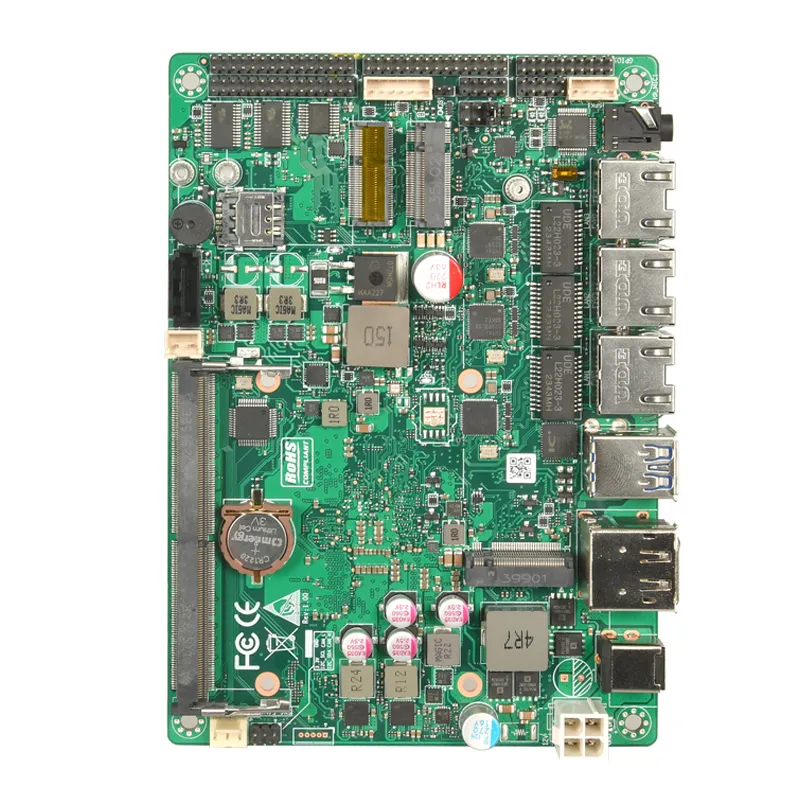
AD743AW
Alder Lake-N · N97–i3-N305
PoE LAN1/2 on 3× i226-V 2.5G, six COM with RS485/RS422, CAN + I2C, DC 9–36V.
Why: PoE on two LAN ports powers vision cameras without injectors; DC 9–36V and −20/+60°C match line cabinets.
View →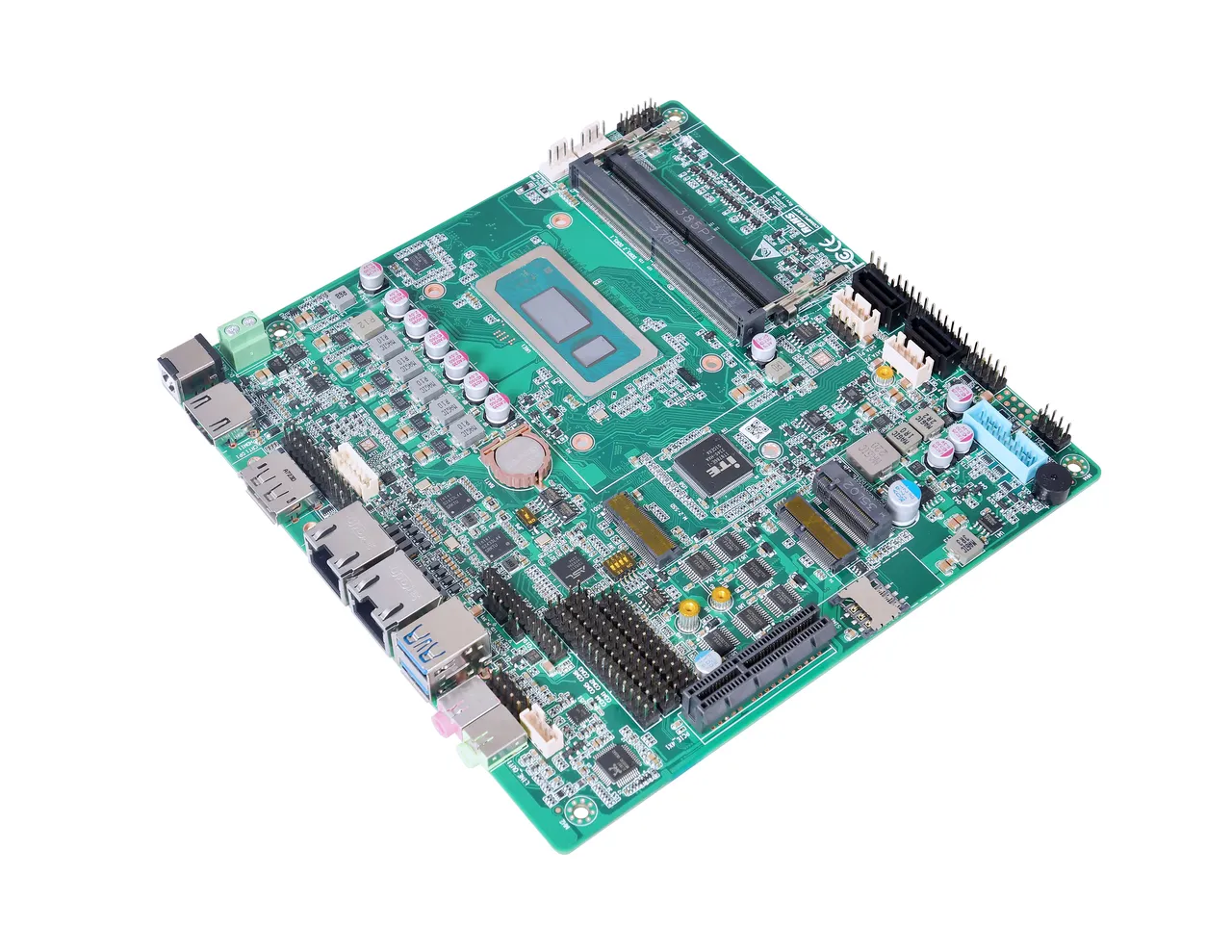
TOP600B
Alder / Raptor Lake · 28W
Six COM with RS485 on COM1/2, LPT/PS/2/GPIO, watchdog 0–255 s, dual i226 2.5G.
Why: six serial ports plus a code-ready watchdog serve MES stations that must recover on their own; B-Key 4G/5G with Micro-SIM backhauls line data.
View →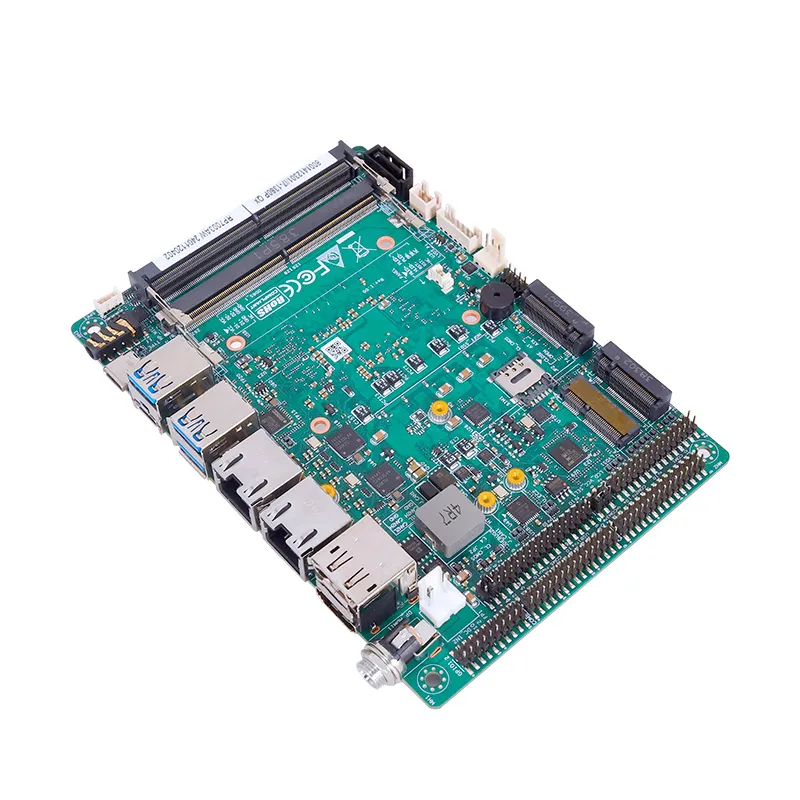
RP7003AW
Core 12th/13th Gen · U/P
Six COM with BIOS-select RS485, 2× CAN, M.2 2280 PCIe 5.0 x4, DC 9–36V 120W.
Why: CAN plus RS485 covers motion and line control; the PCIe 5.0 M.2 slot leaves headroom for analysis workloads at the cell.
View →Line-Side Checklist
Match the requirement, then the board
Typical line requirements against the datasheet fields of the three recommended models.
| Line Requirement | Datasheet Field | On Board |
|---|---|---|
| Cabinet temperature | −20/+60°C operating | AD743AW · TOP600B · RP7003AW |
| 24V plant rail | DC 9–36V wide input | AD743AW · RP7003AW (TOP600B: DC 12–19V) |
| Vision camera feed | PoE LAN1/2, 3× i226-V 2.5G | AD743AW |
| MES serial farm | 6× COM, RS232/RS485 | AD743AW · TOP600B · RP7003AW |
| Fieldbus to controllers | 2× CAN | RP7003AW (AD743AW: CAN + I2C) |
| Self-recovering stations | Watchdog 0–255 s | TOP600B |
| Line data backhaul | B-Key 4G/5G + Micro-SIM | TOP600B (RP7003AW: B-Key USB 2.0/3.0 + PCIe) |
Questions
Factory automation, answered
The AD743AW carries three Intel i226-V 2.5G LAN ports with PoE on LAN1/2, so compact vision cameras can be powered from the board itself instead of a separate PoE injector stack.
The AD743AW, TOP600B and RP7003AW each offer six COM ports with RS232 on most channels and RS232/RS485 selectable on COM1/2 — the AD743AW also makes RS422 selectable in BIOS on COM1/2, so a scanner bank, a label printer and the station PC share one board.
The AD743AW and RP7003AW accept DC 9–36V and ride 12V or 24V rails directly; the TOP600B runs on DC 12–19V, so pair it with a small converter where the cell is fed at 24V.
Model Matrix
Boards matched to factory automation
Models whose published application notes and interface set fit this workload — pulled from the GEOLiNK specification sheets, with the CPU, panel output and power input that matter for the selection.
| Model | CPU | Display | Power |
|---|---|---|---|
| AD600NA | Onboard Intel Alder Lake-U / -P / -H series processor, TDP 28W Available SKUs: I3-1215U / I5-1235U / I5-12450H | 2 x HDMI2.0, supporting 4K@60Hz 1 x DP, supporting 8K@60Hz 1 x Type-C (DP 8K@60Hz + USB3.0) | DC 12-19V, 120W or above |
| AD600Z3AW | Intel 12th / 13th Gen -U / -P Series processors (optional -U / -P / -H Series) TDP: 28W BIOS: EFI BIOS | 1 x HD2.1 1 x 24-bit LVDS (LVDS / eDP selectable) 1 x MiniDP Type-C (USB + DP) | Standard input: DC 9-36V |
| AD742A | Onboard Intel Alder Lake-N series / Intel Twin Lake-N150 series Optional N100 / N305 / N150, with fan [optiona | 1 × HD2.0, 4K@60Hz 1 × LVDS/eDP (LVDS/eDP optional) | Standard input: DC 12V, 60W |
| HK800CA | **Onboard AMD Ryzen AI 9 365** BIOS: EFI BIOS | 2 × HDMI2.0, supporting 3840 × 2160 @ 60 Hz 1 × Type-C, supporting 3840 × 2160 @ 60 Hz and USB3.0 | Input: **DC 12-19V** Power: **90W or above** |
| MSK-TL5003AW | Onboard Intel 11th Gen Tiger Lake-U series, EFI BIOS Optional CPU: Celeron 6305 / i3-1115G4 / i5-1135G7 / i7-1 | HD2.0 interface, supports 4096 x 2160 @ 60 Hz eDP | Standard input: DC 9-36V, 90W |
| PX700CA | Onboard AMD RYZEN 6000/7000 series processor, TDP 35W, EFI BIOS Optional CPU: 6600H, 7735U, 7535U, 7840HS, 794 | 2x HD2.0 interface, supports 4K@60Hz 2x Type-C interface, supports DP 8K@60Hz and USB3.0 | DC 12-19V, 90W and above |
| RP7003AW | **CPU**: Intel Core 12th/13th Generation -U/-P series **BIOS**: EFI BIOS | **Interfaces**: 1 × DP 1.4; 1 × HDMI 2.0; 2 × Type-C **Optional**: 1 × LVDS / EDP (optional) | **Input**: DC 9-36V **Power rating**: 120W |
| TL500Z3AW | Onboard Intel 11th Generation Tiger Lake-U Series Processor EFI BIOS CPU Options: Celeron 6305U / i3-1115G4 / | 1 × HDMI 2.0 1 × LVDS (LVDS / EDP selectable, one of the two) 1 × MiniDP (DP++) Dual-channel 24-bit LVDS / HDM | DC 9-36V, 90W Copper fan heatsink |
Get A Quote
Six COM, PoE and a 24V rail — that is a line, not a spec sheet.
Send the cell layout: cameras, serial devices, bus type and ambient temperature. We’ll name the board and the I/O mapping within 24–48 hours.